

This article, Top 10 Books for Optometry Students Starting in 2025 contains affiliate links to Amazon. Please note, that any products purchased via these links may generate a referral fee for The Eye Care Advocate, which will help keep the website operational.
Embarking on an optometry degree in the UK is an exciting step towards a rewarding career in eye healthcare. To navigate the complexities of vision science, clinical procedures, and ocular disease, investing in the right books for optometry is absolutely essential.
These foundational texts will serve as your trusted companions, providing in-depth knowledge and practical guidance throughout your studies and beyond. Choosing the most suitable books for optometry students can feel daunting with the vast array of resources available. However, investing in core textbooks recommended by educators and experienced practitioners will significantly enhance your learning experience.

The best books for optometry students offer clear explanations, helpful illustrations, and a link between theoretical concepts and real-world clinical scenarios. They are invaluable tools for understanding everything from the intricate anatomy of the eye to the nuances of patient care.
This guide highlights some of the most highly recommended books for optometry students, outlining their key features, potential drawbacks, and what makes them valuable additions to your academic library. These selections are frequently referenced in reading lists and are widely considered indispensable resources for anyone pursuing a career in optometry.
Please note: your optometry course will have its own reading lists and those lists are most suitable for your course. Whilst books may be duplicated between lists, this guide should be used supplementary to your institutions guidance.
Kanski’s Clinical Ophthalmology: Tenth Edition
by Jack J Kanski and John F. Salmon
Amazon Review Rating: 4.3 out of 5 (based on 10 reviews)

What’s it About?: Kanski’s Clinical Ophthalmology, 10th Edition, offers stunning images and in-depth information on common and rare eye diseases. Revised by Dr. John Salmon (Oxford), it retains a succinct text and dynamic visual format. Highly organised and comprehensive, it provides focused guidance on diagnosis and management using bullet points, tables, and 2800+ illustrations. It covers the latest developments across ophthalmology, including imaging and rare conditions. An eBook is included for easy access to this essential resource.
Pros: This book offers a remarkably detailed and comprehensive look at a vast array of eye diseases and conditions. It is renowned for its extensive collection of high-quality colour images and illustrations, which are invaluable for visual learning and understanding complex pathologies. Many experienced eye care professionals worldwide consider Kanski’s a definitive reference, often keeping it within easy reach in their practice. Its depth ensures you’ll have a resource to return to throughout your degree and into your professional life.
Cons: Due to the sheer volume and depth of information, this book can appear quite large and potentially overwhelming, especially for students just starting their journey. Some of the more advanced and rare conditions detailed might not be immediately relevant during your initial years of study, requiring you to focus on the core chapters first. Don’t be put off by this book – as it really is a must by and will serve you for years to come!
Reviews Summary: Readers consistently describe it as an absolute “must-have” and a supremely useful, complete textbook for anyone serious about understanding ocular disease. The clarity, authority, and depth of information are universally praised.
“…there is no other collection of clinical images that compete with this edition, in my opinion as an ophthalmologist.”
“Eye Doctor” – Amazon Review
Why buy?: A solid, in-depth understanding of eye diseases is non-negotiable for any future eye care professional. This book provides that essential foundation with clear explanations and exceptional visuals, making it one of the most important books for optometry students. I still have my copy over 10 years on and still reference some of the more unusual ocular pathology that I encounter.
Clinical Procedures in Primary Eye Care: Fifth Edition
By David B Elliott
Amazon Review Rating: 4.6 out of 5 (based on 46 reviews)

What’s it About?: Clinical Procedures in Primary Eye Care offers a clear, step-by-step guide to essential eye exam techniques, backed by research. It covers modern advances like OCT and wide-field imaging, with supporting digital images. Learn evidence-based methods for diagnosis and management. Online resources include videos and interactive tests. An eBook is included for easy access.
It is essentially the “optometrist’s manual!”
Pros: This book excels at providing clear, step-by-step guidance on performing common eye examination procedures that you will utilise daily in clinical practice. It is firmly based on current research, emphasising the importance of evidence-based optometry. The latest editions are updated to include new technologies, such as Optical Coherence Tomography (OCT), and often come with access to online videos that visually demonstrate techniques, significantly aiding practical learning.
Cons: While comprehensive for primary eye care, specific clinical methods taught might have slight variations depending on the teaching protocols at your particular institution. Access to the valuable online resources usually requires a separate login or code, which can sometimes be a minor inconvenience.
Review Feedback: Students and practitioners frequently highlight this as an excellent, practical introductory guide. They appreciate the clear and concise explanations and find the accompanying online library of photos and videos to be a significant benefit for mastering techniques.
“Very helpful book. helped me pass my OSCES! great investment!”
“Angela” – Amazon Review
Why buy?: Mastering clinical skills is absolutely crucial for becoming a competent optometrist. This book offers a practical, evidence-based guide to performing eye examinations correctly, supported by helpful research context and visual aids, making it one of the most practical books for optometry students. Many of the “Skill Centre” guides that I have created here on The Eye Care Advocate have referenced this book, and I still value it as one of the must have books for optometry students that I engage with.
History and Symptoms: The Eye Examination
By Jason Searle
Amazon Review Rating: 5.0 out of 5 (based on 8 reviews)

What’s it About: This book was written by The Eye Care Advocate himself! Dive into detailed explorations and 20 diverse case studies simulating real-world scenarios, from routine checks to complex systemic conditions. Learn effective questioning, active listening (SOLER model), and time management. Gain expert insights to navigate complex cases, manage emotions, and build rapport. Elevate your diagnostic abilities and become a more astute, compassionate optometrist.
Pros: The book specifically focuses on what I believe is the most crucial skill in accurate diagnosis: effectively taking a patient’s history and understanding their symptoms. It provides structured guidance and practical tips for developing effective questioning techniques to uncover vital information that might not be apparent from objective tests alone. This resource offers a systematic approach to a fundamental skill often learned primarily through clinical observation and trial and error. It helps bridge the gap between theory and patient interaction.
Cons: As this book is dedicated to the art of history taking and symptom analysis, it is designed to be used in conjunction with other textbooks that cover the physical examination procedures and diagnostic techniques. It doesn’t aim to be a comprehensive guide to every aspect of a full eye examination.
Review Feedback: The book has received outstanding praise for its practical insights and structured approach to history-taking in optometry. Readers, including pre-registration students and qualified optometrists, find it invaluable for refining patient interactions and preparing for assessments such as OSCEs. Many commend its real-life examples, engaging format, and the way it enhances confidence in clinical practice. Across the reviews, there’s a strong consensus that your book is a must-have resource for both students and professionals looking to improve their case history and patient communication skills.
“This book is definitely a godsend. The book is an outstanding resource for anyone studying optometry and for pre-registration students.”
“Mushy” – Amazon Review
Why buy?: Learning how to communicate effectively with patients, build rapport, and skillfully gather a comprehensive history is a foundational element of excellent eye care. This book offers specific strategies and insights developed from real-world experience to help you understand patient perspectives and expertly guide your examinations. A thorough history can often point you directly to the correct diagnosis, saving time and preventing missteps – a skill invaluable for all books for optometry students to grasp. It is also a low-priced textbook, meaning you get significant value for your purchase.
You’ll also be supporting The Eye Care Advocate maintain free, regular and high-quality content with every purchase.
Optometry 101: Differential Diagnosis
By Tahiba Begum
Amazon Rating: Not available on Amazon – order direct from Optometry 101.
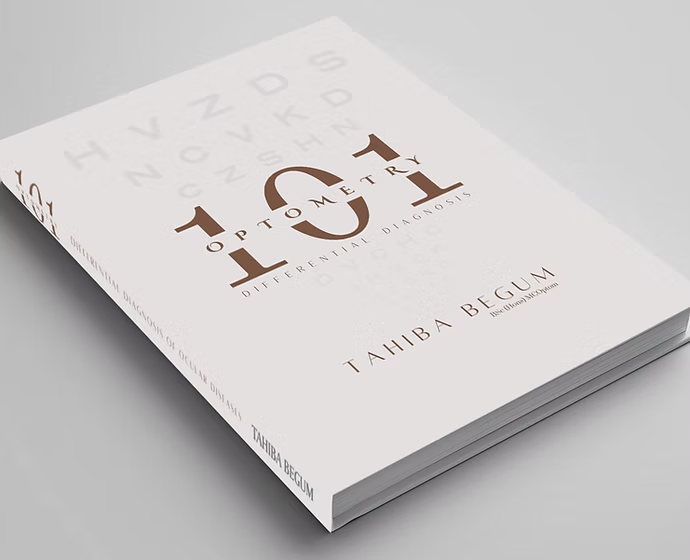
What’s it About?: Differential Diagnosis is a handy UK-focused guide for quickly comparing common eye conditions. It outlines key signs, symptoms, and management, structured by patient-reported symptoms to aid diagnosis. This affordable book helps build confidence in differentiating common ocular pathology for everyday practice.
Pros: This book is specifically designed for everyday optometry practice, helping you compare common eye conditions quickly. It acts as a practical handbook for the testing room, offering a fast reference for common ocular pathology. It can even be personalised with local referral guidelines, aiding patient care continuity, and is useful for pre-reg supervisors to quiz students on key aspects of common eye diseases. For students, it helps learn the signs, symptoms, and management of these conditions, familiarising them with distinguishing features for accurate differentiation and includes a detailed case record template for practice.
Cons: Mainly focuses on differential diagnoses, so won’t delve as deep into the conditions as some of the other ophthalmology and abnormal ocular conditions as some of the other textbooks. That said, it is one of the more practical books for optometry students and well worth the very affordable price.
Review Feedback: Whilst I’ve been unable to find many reviews on the book, @Optometry101 has a popular student and pre-registration optometrist account on Instagram. As such, many have shared great, short testimonials with the account, with many excited by and pleased to own a copy. @Optometry101 is certainly a worthwhile account to follow to see the testimonials for yourself.
“It seems really convenient and handy for an everyday optom, and for a student who’s developing their ability to differentially diagnose”
Testimonial on @Optometry101’s Instagram
Why buy?: If you want a focused, quick-reference guide specifically for telling common eye problems apart in daily practice, this book is for you. It can help you feel more confident in making initial diagnostic decisions. As a lower-priced textbook, it offers targeted support for a key optometry skill: differential diagnosis. While it doesn’t replace comprehensive texts, it can be a valuable, affordable tool for quick reference and building diagnostic confidence, especially when time is limited or during placements. Its practical focus on everyday scenarios makes it a worthwhile investment alongside your core textbooks.
Clinical Anatomy and Physiology of the Visual System: Fourth Edition
By Lee Ann Remington
Amazon Rating: 4.5 out of 5 (based on 26 reviews)

What’s it About?: Clinical Anatomy and Physiology of the Visual System, 4th Edition, provides a concise yet thorough foundation in ocular anatomy and physiology, crucial for understanding clinical situations. Vivid colour illustrations aid visualisation. Clinical Comment sections highlight real-world applications. It features new OCT, OCTA, MRI, and CT images, linking anatomy to modern imaging. Current topics like myopia progression and glaucoma surgery are covered. Updated terminology and an enhanced eBook are included.
Pros: This textbook is specifically tailored for the needs of optometry students, providing a focused and relevant exploration of the eye’s structure and function. It excels at linking basic scientific principles of anatomy and physiology directly to the real-world clinical scenarios you will encounter during your degree and in practice. The text is significantly enhanced with vivid, full-colour illustrations and diagrams which are invaluable for visualising complex anatomical details and physiological processes.
Cons: While written for optometry, some students might initially find the level of anatomical detail quite intense. The integration of modern imaging techniques, while valuable for demonstrating clinical relevance, might be more fully appreciated in later years after gaining more clinical context.
Review Feedback: Many students laud this book for its suitability for optometry programmes, praising the clarity of its explanations and the exceptional helpfulness of the illustrations in making difficult concepts understandable.
“This is an incredibly comprehensive book for the eye. Make learning the ins and outs so much easier. Best purchase I made for school.”
“Mike” – Amazon Review
Why buy?: A robust understanding of the eye’s anatomy and how it functions (physiology) is absolutely fundamental to the practice of optometry. This book provides a clear, relevant, and visually rich foundation specifically tailored for your educational needs, making it one of the core books for optometry students.
Adler’s Physiology of the Eye: Twelfth Edition
By Leonard A Levin, Paul L Kaufman and Mary Elizabeth Hartnett
Amazon Rating: 5.0 out of 5 (based on one review)

What’s it About?: Adler’s Physiology of the Eye, a Doody’s Core Title, enhances understanding of ocular function, structure, and anatomy by linking basic science to clinical practice in a visual format. The updated 12th edition covers the latest molecular, genetic, and biochemical discoveries, including OCT/OCTA imaging and gene therapies. Organised by function, it explains key principles like visual acuity and intraocular pressure. With 1000 illustrations and an eBook, it’s ideal for study and exam preparation.
Pros: For students seeking a truly deep dive into the intricate physiological mechanisms of the eye and visual system, Adler’s is a highly respected and exceptionally thorough resource. It effectively bridges the gap between the basic science of the eye and its clinical applications, often in a user-friendly manner despite its complexity. The latest editions incorporate cutting-edge research and the most recent discoveries in molecular biology, genetics, and biochemistry as they relate to vision.
Cons: The level of detail is quite advanced, potentially exceeding the requirements for introductory-level physiology courses in some programmes. Its organisation by function rather than purely anatomical structure, while logical, might require a slight adjustment if you are more accustomed to a regional anatomical approach.
Review Feedback: Readers consistently highlight its thoroughness and its value as a comprehensive, authoritative source for understanding the profound complexities of ocular physiology at a very detailed level.
“If you want a source for optics, biochemistry, physiology and general information on the eye, this is the one.”
“Ian” – Amazon Review
Why buy?: If you aspire to gain a highly detailed, expert-level understanding of precisely how the eye and visual pathways function at a biological and cellular level, this book offers unparalleled depth and is a valuable addition to the collection of any serious student’s books for optometry students.
Introduction to Visual Optics: A Light Approach
By Samantha Strong
Amazon Rating: 4.7 out of 5 (based on 4 reviews)

What’s it About?: Introduction to Visual Optics: A Light Approach makes learning visual optics easy and engaging. Covering refraction, reflection, and vergence in a fun format, it uses colourful visuals by Dr. Samantha Strong. It explains ophthalmic imaging principles and includes at-home experiments with videos. With 200 practice questions and an eBook, it’s perfect for optometry students and eye care professionals seeking a clear, approachable understanding of this complex subject.
Pros: This book offers a refreshing, accessible, and engaging way to learn about visual optics, a subject often perceived as challenging by new students. It covers the fundamental basics in a conversational, easy-to-read style, liberally using colourful illustrations and practical, relatable examples. The inclusion of suggested at-home experiments and demonstration videos helps to solidify your understanding of key, often abstract, concepts by making them more tangible.
Cons: As its title suggests, this is an introductory text. While excellent for building initial understanding, it will not cover the more advanced or complex topics in optics that you will delve into during the later years of your degree programme. That said, it provides an excellent foundation on which to build upon.
Review Feedback: Students frequently praise its conversational tone, clear organisation, and the effectiveness of its visual aids in demystifying complex optical ideas and making the subject enjoyable. One of the must-have books for optometry students and optometrists alike.
“Dr Strong’s writing is excellent. She manages to strike a balance between writing in a conversational tone and including the necessary details that I think is very effective”
Ben Balas – Optometry and Vision Science Review
Why buy?: Grasping the fundamentals of how light behaves and interacts with the eye is absolutely crucial for understanding vision correction and many clinical concepts. This book provides a clear, engaging, and accessible entry point into this vital area of study, making it a highly recommended introductory text among books for optometry students.
The Optometrist’s Guide: Communication, Better Care, Better Commercial Results
By The Optics Communication Coach
Amazon Rating: 4.8 out of 5 (based on 8 reviews)

What’s it About?: Discover how to become a memorable optometrist patients rave about. Learn communication secrets to conduct engaging eye tests, make compelling product recommendations, and be known as thorough without extra time.
Create excitement about eyewear and elevate your career with practical, immediately applicable steps to enhance your patient interactions.
Pros: This book offers practical, easy-to-use communication techniques for optometrists. It presents clear and concise advice in an engaging style, often using relatable stories. Even experienced optometrists find valuable insights to improve patient interactions. Many consider it a game-changer for enhancing how they connect with patients.
Cons: Communication is a key skill, but many of these techniques may not come in to play until you reach your patient clinics or placements. That said, an early purchase to get these methods internalised will mean you can hit the ground running for when these skills really matter.
Review Feedback: Experienced optometrists found it a thoroughly enjoyable and useful read, gaining new perspectives even after 10 years in practice. They noted improvements in patient satisfaction and conversion rates after applying the book’s suggestions. They strongly recommend it for students and new graduates to build strong communication skills early on.
“Every optom should read this book.”
John – Amazon Review
Why buy? If you want to become a more engaging and effective communicator, leading to happier patients and potentially better business results, this book offers valuable insights. It provides practical steps that can be put into practice immediately, benefiting both new and experienced optometrists. Building strong communication skills early in your career is crucial, and this book can help you do just that. It is low-priced so provides a lot of value without setting you back much!
Optometry: Science, Techniques and Clinical Management
By Mark Rosenfield and Nicola Logan
Amazon Rating: 4.7 out of 5 (based on 17 reviews)

What’s it About?: This book introduces optometry theory and practice, from vision science to managing common eye conditions. Updated with full colour and 400+ illustrations, it reflects modern technology and clinical procedures. Covering anatomy, techniques, and patient management (including special populations and refractive correction), it’s ideal for students, new graduates, and experienced practitioners seeking a rapid reference on optometric care.
Pros: This book offers a broad yet concise introduction to the entire field of optometry, covering the science, clinical techniques, and management of common eye conditions. The latest edition features full-colour illustrations and incorporates recent technological advancements in the field. Contributions from international experts provide a global view of optometric practice.
Cons: Given its broad scope, it might not delve into extensive detail on specific topics. However, it is of great use when combined with the other books for optometry students.
Review Feedback: Reviewers often highlight its value as an introductory text that provides a good overview for both students and new practitioners.
“Pretty much summarises optometry well, and not too complicated. Good use of diagrams and not just pages of words.”
“Zakir” – Amazon Review
Why buy?: This book gives you a good sense of the whole landscape of optometry, helping you understand how different areas connect. This can be fairly important when you are just starting out in your studies.
System for Ophthalmic Dispensing: Fourth Edition
By Clifford W Brooks
Amazon Rating: 4.9 out of 5 (based on 20 reviews)

What’s it About?: Understand eyewear needs with System for Ophthalmic Dispensing. This guide covers everything from basic terms to frame selection, fitting, and repairs. Learn the “how” and “why” of lens choices, including specialised types. Packed with illustrations and review questions, it’s perfect for students and practitioners. An eBook is included for easy access. Master the essential skills of ophthalmic dispensing.
Pros: Considered the definitive guide on how to properly fit and adjust eyewear, this book covers every aspect of ophthalmic dispensing. It explains different types of lenses and provides a step-by-step system for the process. It’s a key resource for understanding the practical side of providing vision correction.
Cons: The detailed focus on dispensing might be more relevant in later stages of your education or if you have a particular interest in this area early on. It is also more US-centric, so be aware of the standards used as some details may be lost between UK and US regulations.
Review Feedback: Many consider it a phenomenal reference for opticians and anyone working with eyewear, praising its comprehensive coverage.
“I loved the in-depth examples and pictures for how to adjust and repair eyewear”
“MissGoldfish” – Amazon Review
Why buy?: Understanding the principles of dispensing is an integral part of optometry, and this book offers a thorough introduction.
Conclusion
Even in this digital age, these textbooks remain vital tools for your optometry education. Books for optometry students offer a structured and in-depth understanding that complements lectures and online resources. Taking the time to truly study these books, not just skim them, will build a strong foundation for your future practice.
We’ve recommended Amazon as a convenient retailer, and it’s worth considering Amazon Prime Student. The free delivery on many items can save you money throughout your degree; as well as Amazon currently offering a free 6-month trial to eligible students! Additionally, there are many student offers on books for optometry students – so you could even save more!
Please be aware that purchases made via the links in this article may generate a small income from Amazon for our website. This helps us dedicate time to creating the guides and resources you find valuable.
Ready for support beyond textbooks? Sign up for a free The Eye Care Advocate membership to access all our Skill Centre guides and further enhance your optometry journey.

Leave a Reply