
Tag: students
-
Why Clinical Mistakes in Optometry Are Your Best Teachers
We spend years anchored in the safety of theory, devouring textbooks, memorising pathologies, and sitting through endless lectures. Theory is comfortable because every patient follows the exact rules of the page. But the moment you step into a real-life clinic, you realise the environment is dynamic and entirely unpredictable. Real patients haven’t read the textbooks.…
-

How Tornadoes Lowered My Clinical Uncertainty in Optometry
I will start by saying that this is not your usual eyecare article, but reflecting back on my other life experiences, I look at how they have helped me become the optometrist that I am today. In this case, we look at how my history with storms has helped me tackle the battles with clinical…
-

Why a Purpose-Built Clinical Kit is a Necessity, Not a Luxury
This post is a review of the newly-launched “OptoKit by AK“. I was lucky enough to have an early-peek at this new project by Aaminah Khan and I have offered to write a review based on my findings of this new clinical kit, after putting it to the test in several of my clinics. Several…
-

Recommended Books for Optometry Students Starting in 2026
This article discussing my recommended books for optometry students starting in 2026 contains affiliate links to Amazon. Any products purchased via these links may generate a referral fee for The Eye Care Advocate. Embarking on an optometry degree in the UK in 2026 is an incredible milestone. To navigate the complexities of vision science and…
-

Providing Essential Optometry Resources to Help You Thrive
The transition from A-Levels to university-level clinical science is a massive leap. One month you are studying biology diagrams, and the next you are expected to grasp complex neurophysiology while learning how to hold a retinoscope without dropping it. If you feel overwhelmed, you are not alone. It is a completely normal part of the…
-

Beyond the Mnemonic: LOFTSEA for the Clinically Unfamiliar
I am delighted to welcome a guest post from my respected colleague, Andy Millington. In this piece, Andy breaks down the difference between simply recalling the LOFTSEA mnemonic and using it as a sophisticated framework for clinical processing. Andy builds on some of the key aspects described in History and Symptoms: The Eye Examination, building…
-
Mastering Your Static Retinoscopy Technique: A Student Guide
In the modern world, where automated eye exams are creeping in, there is one skill that remains the ultimate “lie detector” for an optometrist: static retinoscopy. Also known as “skiascopy,” this is the art of objectively measuring a patient’s refractive error using nothing but light and lenses. While auto-refractors are quick, they can be fooled…
-
Why “PERRLA” is Often a Lie: How to Master Effective Pupil Assessments
Have you ever seen “PERRLA” written in a patient’s notes, only to realise they are 80 years old and have artificial lenses? Since accommodation (the “A” in PERRLA) is physically impossible for a pseudophakic patient, that clinical recording tells us the assessment was likely rushed or “auto-filled”. Pupil assessment is the bridge between the eye…
-
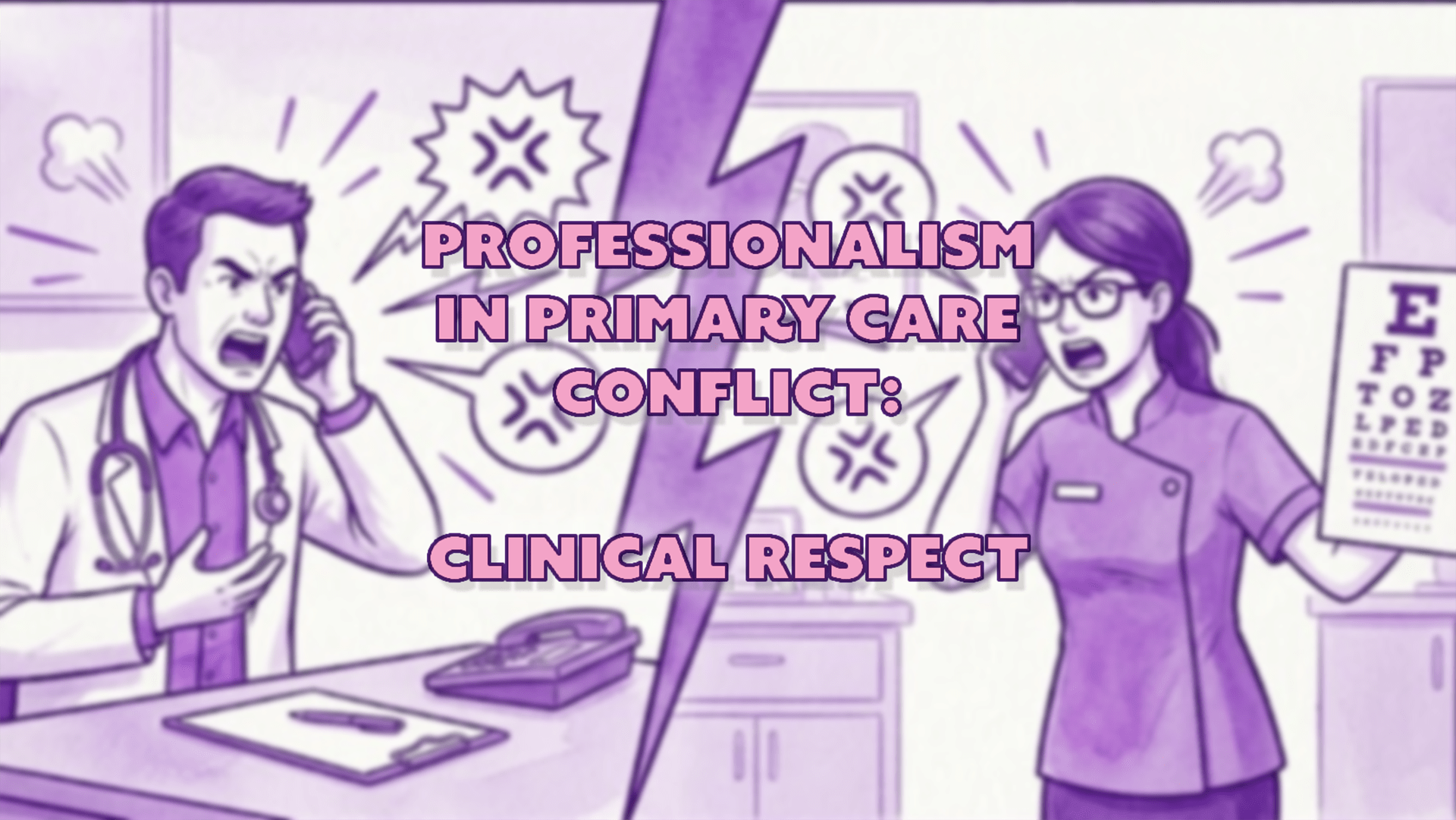
Professionalism in Primary Care Conflict: Clinical Respect
The landscape of UK healthcare is changing, and with it, the way professionals interact. A recent viral social media video featuring a GP’s “pet peeves” about eye care recommendations has recently sparked significant debate across the clinical community. While social media offers a platform for connection, it also acts as a catalyst for primary care…
-

Duty of Candour: Your Professional Guide to Honesty and Trust
As healthcare professionals, we hold one duty to be sacred. This is the duty of candour. But what does this phrase actually mean? It is not just a buzzword. It is the absolute core of our patient-practitioner relationship and is the foundation of trust. I have written this guide to explain exactly what the duty…