
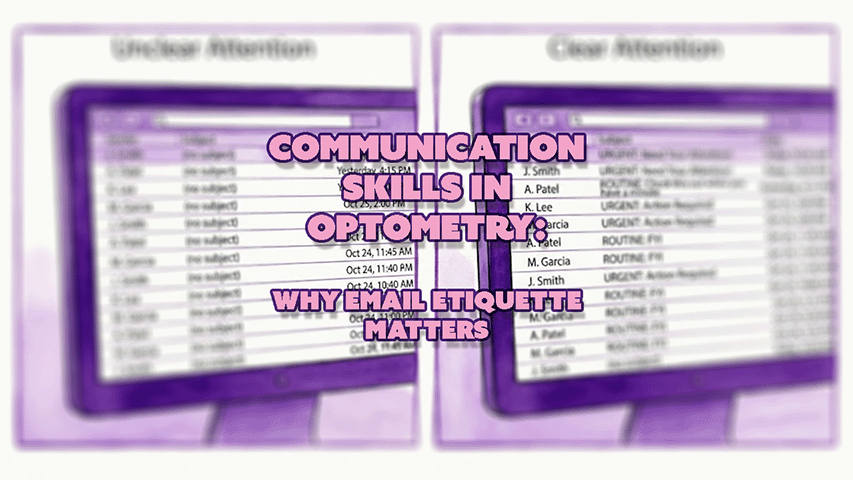
There is a fascinating story from the world of gaming that perfectly highlights the shift we are seeing in digital interaction, especially regarding communication skills. The developers of a game called “After Hours” noticed their support system was failing. Players were sending emails for help, but the system couldn’t process them. Why? Because the players were putting their entire message in the subject line and leaving the body of the email completely blank.
This wasn’t an act of laziness. It was a user interface clash. For a generation raised on Discord, WhatsApp, and Teams, communication is a continuous stream. The distinction between a “subject” and a “message” feels obsolete to them. This phenomenon, often called the “Slack-ification” of email, is a documented trend where professional correspondence is becoming indistinguishable from instant messaging.
However, while the gaming world might adapt its code, the medical world moves much slower. This is why developing strong communication skills in optometry is about more than just politeness; it is a fundamental part of your clinical toolkit in additional to other clinical skills.
The Generational Shift in Communication
We are living through a unique time where the structure of the working world—built largely by previous generations—is clashing with the digital habits of the new workforce. If you are a student or a pre-reg, you might find the rigid structure of a formal email feels stiff, cold, or unnecessary. You might wonder, “Why do I need a subject line? Why do I need to sign off? Isn’t it more efficient to just say what I need?”
I want to be clear: this isn’t a failing on your part. It is a difference in “digital dialect.” However, communication skills in optometry rely heavily on that older structure. When you enter a practice or a hospital, you are entering a world that runs on formal documentation. Mastering these communication skills in optometry is the bridge between your clinical knowledge and your professional reputation.

The “Ghost” Email: A Personal Experience
I recently received an email that perfectly illustrates this gap. It arrived in my inbox with no subject line. There was no opening salutation—no “Dear Jason,” or even a “Hi.” It just launched straight into a question.
My immediate reaction wasn’t anger; it was confusion. My inbox is a busy place, filled with spam, notifications, and genuine enquiries. When I see an email with no subject, my brain instantly filters it as “potential junk” or “phishing.” I found myself hesitating to open it. Is this real? Is this safe?
The sender was actually a lovely student who was very complimentary about my work. But because the email lacked the basic markers of professional communication skills in optometry, my first impression was one of caution, not connection. In a professional setting, you never want the recipient to have to work hard to understand who you are or what you want.
Why Communication Skills in Optometry Are a Safety Issue
You might be thinking, “Jason, it’s just an email. Does it really matter?”
In our profession, yes. Communication skills in optometry are inextricably linked to patient safety.
Imagine you are referring a patient for a suspect retinal detachment. You type a quick referral letter to the ophthalmologist. Because you are used to the “texting mindset,” you use informal abbreviations, you skip the clear subject header, or you fail to address the consultant by their title.
When that email hits the triage nurse’s inbox, it doesn’t look like a medical emergency; it looks like a casual note. It might be triaged incorrectly. The patient might be delayed. In the worst-case scenario, if a complaint arises later, informal language makes it much harder to defend your professional conduct.
Effective communication skills in optometry ensure that your message is taken seriously. A well-structured email acts as a first impression. Research consistently shows that we form judgments about competence based on initial interactions. If your written communication is polished, the receiver assumes your clinical skills are equally polished. If it is “slapdash,” they may subconsciously assume your clinical skills are too.
The Hidden Curriculum and The Anxiety Gap
I know that for many of you, this is stressful. Universities are excellent at teaching anatomy and optics, but they often struggle to teach the “Hidden Curriculum”—the unwritten rules of professional behaviour. Communication skills in optometry often fall into this gap.
It is documented that many students write bluntly not because they are rude, but because they are anxious. You might fear using “Yours Sincerely” incorrectly, so you default to a safer, casual “Hi.”
This is normal. I have been there. But remember, communication skills in optometry are learned, just like using a slit lamp. It is okay to ask. It is okay to Google “how to sign off a formal email.” It is far better to attempt formality and get it slightly wrong than to abandon it entirely.

Code-Switching and “Enclothed Cognition” as Communication Skills
The secret to mastering communication skills in optometry is “code-switching.” This is the ability to toggle between different modes of speech. I speak to my wife differently than I speak to a patient. I text my friends differently than I email a Professor.
Think of it like putting on a uniform. There is a psychological concept called “Enclothed Cognition” (studied by Hajo Adam and Adam D. Galinsky), which suggests that what we wear influences how we think. When you put on a lab coat or a tunic, you feel more professional. You need to apply that same “uniform” to your writing. When you sit down to email a supervisor or a consultant, mentally put on your “professional hat.”
Communication skills in optometry require you to recognise your audience. If you are WhatsApping a clinic buddy, emojis are fine. If you are emailing a practice owner for a job, you need the full structure: Subject Line, Salutation, Body, Sign-off.
Recommended Reading
If you want to dive deeper into the psychology of interaction and professional growth, I highly recommend these two books. They are fantastic for developing communication skills in optometry and beyond:

“The Unspoken Rules: Secrets to Starting Your Career Off Right”
by Gorick Ng
This book specifically tackles the “hidden curriculum” we discussed, helping you navigate the workplace with confidence.
“How to Win Friends and Influence People”
by Dale Carnegie.
A classic for a reason. It teaches the fundamental human psychology that underpins all successful interactions.

(Note: These are Amazon affiliate links, purchasing through them supports the blog at no extra cost to you).
The Student Blueprint: Written Communication Skills Under the Spotlight
I am passionate about ensuring the next generation of optometrists is the best it can be. That is why I am developing The Student Blueprint, a comprehensive course designed to bridge the gap between university and the real world.
A key topic in this course is “Mastering Email Communication” We dive deep into the specific communication skills you need to succeed in optometry. We cover:
- Email Templates: Copy-and-paste scripts for contacting employers.
- The “Subject Line” Test: How to ensure your email gets opened.
- Referral Emails: How to write emails that keep your patients safe.
The Student Blueprint is available right now as part of The Eye Care Community.
🚀 LAUNCH OFFER: Join before January 31st, 2026, to lock in our Founding Member rates for life:
- Student Advocate:
£10/month (Standard £15/month)
- Professional Advocate:
£20/month (Standard £30/month)
Membership gives you access to this course, plus “Ret Mess to Ret Success,” my book, and a network of mentors ready to help you navigate your career. There are a whole host of reasons to sign up if you are a student optometrist, going through CLiP or Pre-Reg, or even as a qualified optometrist!
If you wish to just purchase the course alone, it has a stand alone price of £30.
Mastering communication skills in optometry doesn’t have to be scary. It just takes a little practice and the right guidance. Let’s make sure you stand out for all the right reasons.
Commuication Skills: Frequently Asked Questions
Does the subject line of an email really matter?
Yes, absolutely. In a busy optometric practice or hospital, the subject line is the triage tool. A subject line like “Pre-Reg Application: [Name] – 2027 Cohort” tells the receiver exactly who you are and what you need immediately. Leaving it blank increases the risk of your email being deleted or caught in spam filters.
Is it okay to start an email with “Hi”?
It depends on the audience. Communication skills in optometry are about context. If you are emailing a peer or a close colleague, “Hi” is fine. If you are emailing a consultant, a potential employer, or someone you have never met, “Dear [Name]” is the professional standard. It shows respect and professional maturity.
What if I don’t know the name of the person I am emailing?
This is a common source of anxiety. If you can’t find a name after a quick search, “Dear Practice Manager” or “Dear Hiring Team” is perfectly acceptable. It is infinitely better than “Hi” or no salutation at all.
How does email etiquette affect patient safety?
Poorly written emails or referrals can be ambiguous. In optometry, ambiguity is dangerous. Using “text speak,” lacking structure, or missing key details because you are rushing can lead to triage errors in ophthalmology. Clear, formal writing minimises the risk of misinterpretation.
What is the “Hidden Curriculum”?
The Hidden Curriculum refers to the unwritten rules, values, and behaviours that are expected in a professional workplace but are rarely taught in university lectures. This includes email etiquette, how to dress, and how to address superiors. The Student Blueprint is designed to reveal these rules.
I’m anxious about sounding “stiff” or “fake.” What should I do?
It often feels “fake” because you aren’t used to it yet. Think of it as learning a new clinical technique. It feels awkward at first, but eventually, it becomes muscle memory. Adopting a professional tone isn’t about changing who you are; it’s about respecting the professional environment you are entering.
Where can I find templates for professional emails?
My course, The Student Blueprint, includes a dedicated module on Written Communication. It provides three simple templates (job applications, referrals, and general enquiries) to take the stress out of writing. This is available exclusively in The Eye Care Advocate Community.
Leave a Reply