
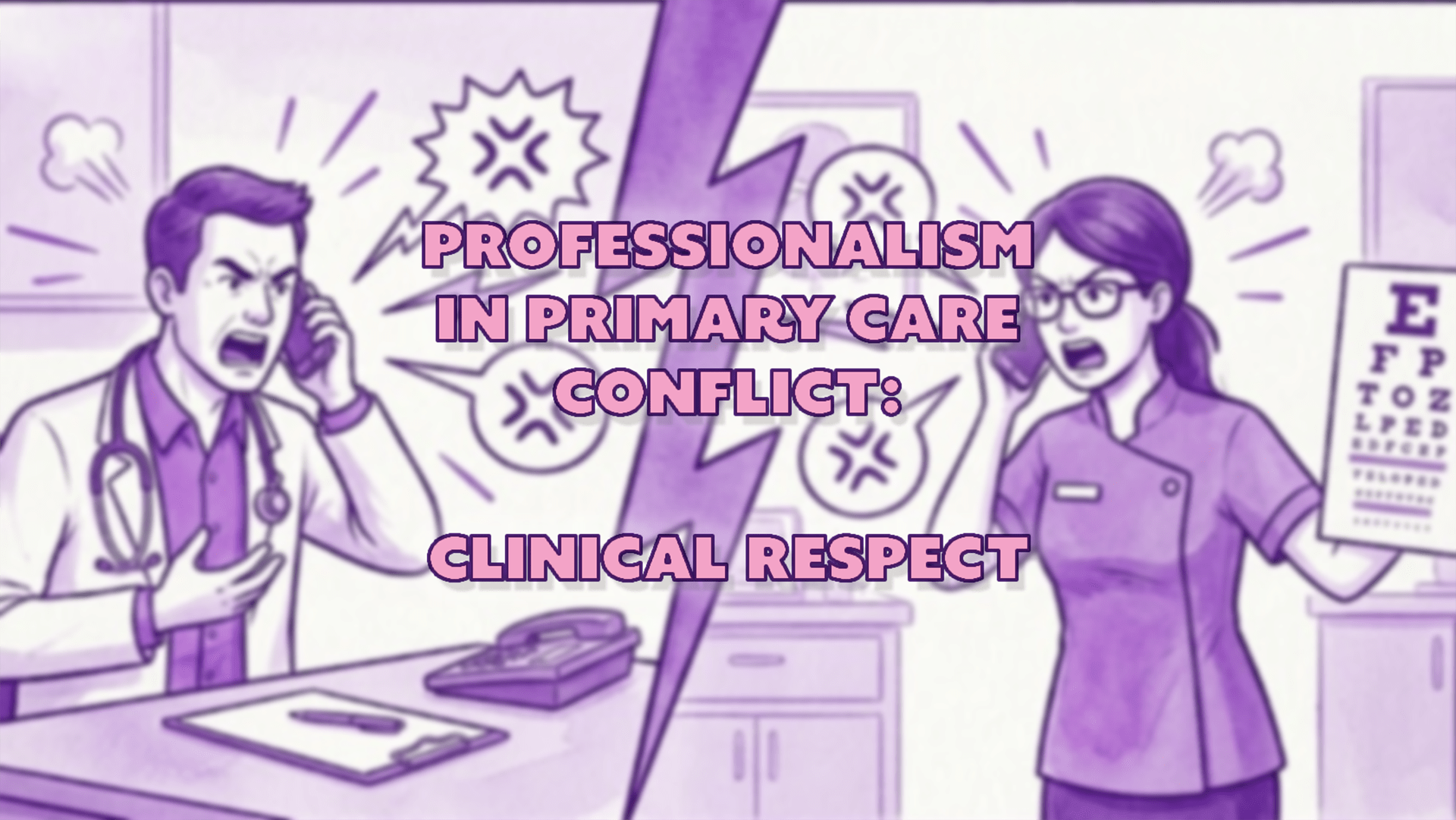
The landscape of UK healthcare is changing, and with it, the way professionals interact. A recent viral social media video featuring a GP’s “pet peeves” about eye care recommendations has recently sparked significant debate across the clinical community. While social media offers a platform for connection, it also acts as a catalyst for primary care conflict. Many of the comments following the video highlighted a derogatory and misinformed tone that, unfortunately, undermines the inter-professional trust essential for patient safety.
When a healthcare professional publicly disparages the clinical judgment of another, it does more than just hurt feelings; it erodes the public’s confidence in the entire medical system. However, we should not view these moments as mere setbacks. Instead, they serve as a vital prompt to examine how we can build better systems, collaborate more effectively, and protect the integrity of all healthcare disciplines.
Key Takeaways
Building, Not Breaking:
We must protect the integrity of all healthcare colleagues to maintain the standing of primary care as a whole.
Systemic Roots:
Inter-professional friction is often fueled by systemic pressures—like the GOS fee freeze and restrictive GP formularies—rather than individual failings.
Professional Standards:
Both GOC and GMC standards mandate mutual respect. Publicly airing grievances risks bringing the professions into disrepute and eroding public trust.
Shared Pathways:
Moving from “gatekeeper” roles to collaborative pathways like MECS ensures patients receive the right care without unnecessary conflict.
The Anatomy of Disconnect
Primary care conflict rarely begins with malice. It usually starts with a diagnostic or procedural disconnect. In the viral video in question, the GP dismissed dry eye recommendations as “drama” or a “sales trick.” This highlights a fundamental misunderstanding of the tools used in different settings. Generally speaking, the GP relies on a pentorch or direct ophthalmoscope, which is excellent for general screening but lacks the magnification required for ocular surface pathology.
Conversely, an optometrist uses a slit lamp to observe microscopic changes in the tear film and corneal epithelium. When clinical findings are dismissed because they are invisible to a pentorch, it creates a “specialist vs. generalist” tension.
This friction is exacerbated by the economic reality of the high street. The General Ophthalmic Services (GOS) fee has been frozen in real terms for years, and most practices provide complex clinical care at a significant financial loss. To suggest that clinical advice is motivated by a small markup on a bottle of drops is not only factually incorrect but undermines the clinical evidence-base that drives our decision-making.

From Conflict to Collaboration
This diagnostic gap naturally rolls into a procedural one. We often see primary care conflict arise when patients ask for over-the-counter (OTC) recommendations on an NHS prescription. The GP, feeling the pressure of restrictive prescribing formularies, often directs their frustration at the optometrist rather than the systemic issue.
To bridge this gap, we must transition from isolated working to a truly integrated team. Professionalism dictates that we lead with logic. If an optometrist recommends a specific formulation (such as a preservative-free sodium hyaluronate) it is often to prevent long-term corneal damage from generic, preserved alternatives.
If this is communicated clearly through shared pathways like the Minor Eye Conditions Service (MECS), the GP is no longer a “gatekeeper” but a partner in a clinical pathway. This will effectively lessen their workload. Collaboration is not about agreeing on everything; it is about respecting the unique expertise each practitioner brings to the table to ensure the patient receives the most appropriate care.
Protecting Professional Integrity on Social Media
The digital age has turned professional disagreements into public spectacles. The GMC’s Good Medical Practice and the GOC’s Standards for Optical Professionals both emphasise the duty to treat colleagues with respect and maintain public trust. When primary care conflict is aired publicly with a dismissive tone, it risks violating these regulatory frameworks.
Derogatory comments on social media can be viewed as “bringing the profession into disrepute.” Instead of using platforms to sow distrust, we should use them to highlight the complexities of modern primary care. We must protect the integrity of our colleagues to protect our own. If we allow one profession to be belittled, we weaken the standing of all primary care providers. Professionalism in the digital age requires us to be “builders” of reputation, not critics who trade in half-truths or tropes for the sake of engagement.
It must be said to remove any element of doubt that this applies across all healthcare professionals – not just limited to the case in the viral video mentioned.
Building a Stronger Community
At The Eye Care Advocate, we believe that the best way to resolve primary care conflict is through a strategic moral compass and proactive advocacy. We don’t just judge the current state of the industry; we build the tools to improve it. Our community is a core component of this mission, providing a space where practitioners can navigate these very conflicts with peer support and intellectual honesty.
The Eye Care Advocate Community is designed for those who want to move beyond the “fraught” nature of current healthcare relationships. We focus on:
- Strategic Advocacy: Learning how to communicate the value of optometry.
- Professional Standards: Navigating the ethical minefields of social media and inter-professional referrals.
- Integrity and Growth: Building a practice and a career based on fairness, personal autonomy, and high clinical standards.
If you are tired of clinical isolation and the “us vs. them” narrative, our premium community offers the resources to help you lead with logic and empathy. By joining, you aren’t just getting support; you are contributing to a fairer, better-funded, and more respected eye care sector.

A Unified Future for Primary Care
Ultimately, resolving primary care conflict is about centring the patient. Every minute spent in professional infighting is a minute taken away from patient care. We must move past the “pet peeves” and focus on the fact that high-street optometry serves as a vital clinical hub, diverting millions from overwhelmed GP surgeries and A&E departments.
We must advocate for better GOS funding, more Independent Prescribing (IP) roles, and integrated digital communication between surgeries and practices. When we see a colleague’s “opposing view,” we should see an opportunity for education rather than an occasion for an attack.
By protecting the integrity of all healthcare professionals, we ensure that the NHS remains a cohesive, trusted system. Let us use the recent viral discourse as a turning point; a moment to reaffirm our commitment to professionalism, collaboration, and the shared goal of a healthier community.
Thank you for taking the time to read this post. I am passionate about eye care, eye care professionals and building a better atmosphere that helps develop high-calibre eyecare professionals with the view this will improve patient care across the UK.
I would appreciate your thoughts on this article – as I have re-written it several times and wanted to ensure the message was an objective one that all parties can benefit.
If you would like to see how The Eye Care Advocate Community and its resources can help you, you can read more on our community home page.
Common Questions
Why does my optometrist recommend a specific eye drop that isn’t on my GP’s prescription list?
Optometrists recommend specific formulations, such as preservative-free drops or drops which target specific causes of dry eye, based on clinical evidence to prevent long-term corneal damage and maximise comfort. GPs often have restrictive prescribing formularies they must follow that do not allow prescribing of some specific eye drops.
Can an optometrist refer me directly to a hospital specialist?
In many areas across the UK, optometrists can refer patients directly to secondary care through electronic referral systems or services like MECS. However, in some regions, the GP still acts as the primary gateway for NHS referrals to ensure the patient’s full medical history is considered.
What should I do if my GP and optometrist give conflicting advice?
Patients are encouraged to ask both practitioners to communicate. High-quality eye care relies on collaboration. If you receive conflicting advice, you can request that your optometrist sends a formal clinical report to your GP to explain the diagnostic reasoning behind their recommendation.
Is high-street optometry part of the NHS?
Yes, high-street optometry is a vital clinical hub of the NHS. Optometrists provide General Ophthalmic Services (GOS), which include NHS-funded sight tests for eligible patients, and increasingly manage complex clinical cases that would otherwise require a GP or A&E visit.
However, due to ongoing stagnation of what the NHS will pay for an NHS-funded sight test has meant some are now only offering private services.
Why are some eye care services not free on the NHS?
While the NHS covers basic sight tests for certain groups, the General Ophthalmic Services (GOS) fee has been frozen for many years. This means specialised clinical equipment and advanced diagnostic tests often require a private fee to ensure the practice can maintain high clinical standards.
What are the GOC Standards for social media use?
The General Optical Council (GOC) requires registered professionals to maintain public trust and treat colleagues with respect, even online. Derogatory comments or “bringing the profession into disrepute” on social media can lead to fitness-to-practise investigations.
How can GPs and optometrists work better together?
It must be stressed that in many cases, they work together well. The most effective way to improve collaboration is through integrated digital communication and the use of shared care pathways (such as MECS or CUES). This reduces the “gatekeeper” pressure on GPs and utilises the specialist diagnostic tools and skills available in optometry practices.
Can I get preservative-free eye drops on an NHS prescription?
Whether you can receive specific drops on an NHS prescription depends on your local Integrated Care Board (ICB) formulary. While optometrists may recommend them for clinical health, GPs may be limited to prescribing what is locally funded, leading to potential primary care conflict.
What is the Minor Eye Conditions Service (MECS)?
MECS is an NHS-funded service where patients with acute eye problems (like red eyes, flashes, or floaters) can be seen by a specially trained optometrist. This service is designed to take pressure off GP surgeries and hospital eye departments, whilst providing a more localised service closer to where patients live.
Why is professional integrity important in primary care?
Professional integrity ensures that patient care remains the priority. When healthcare professionals respect each other’s unique expertise, it creates a safer, more efficient system. Publicly undermining colleagues weakens the standing of all primary care providers and erodes patient confidence.


Leave a Reply