
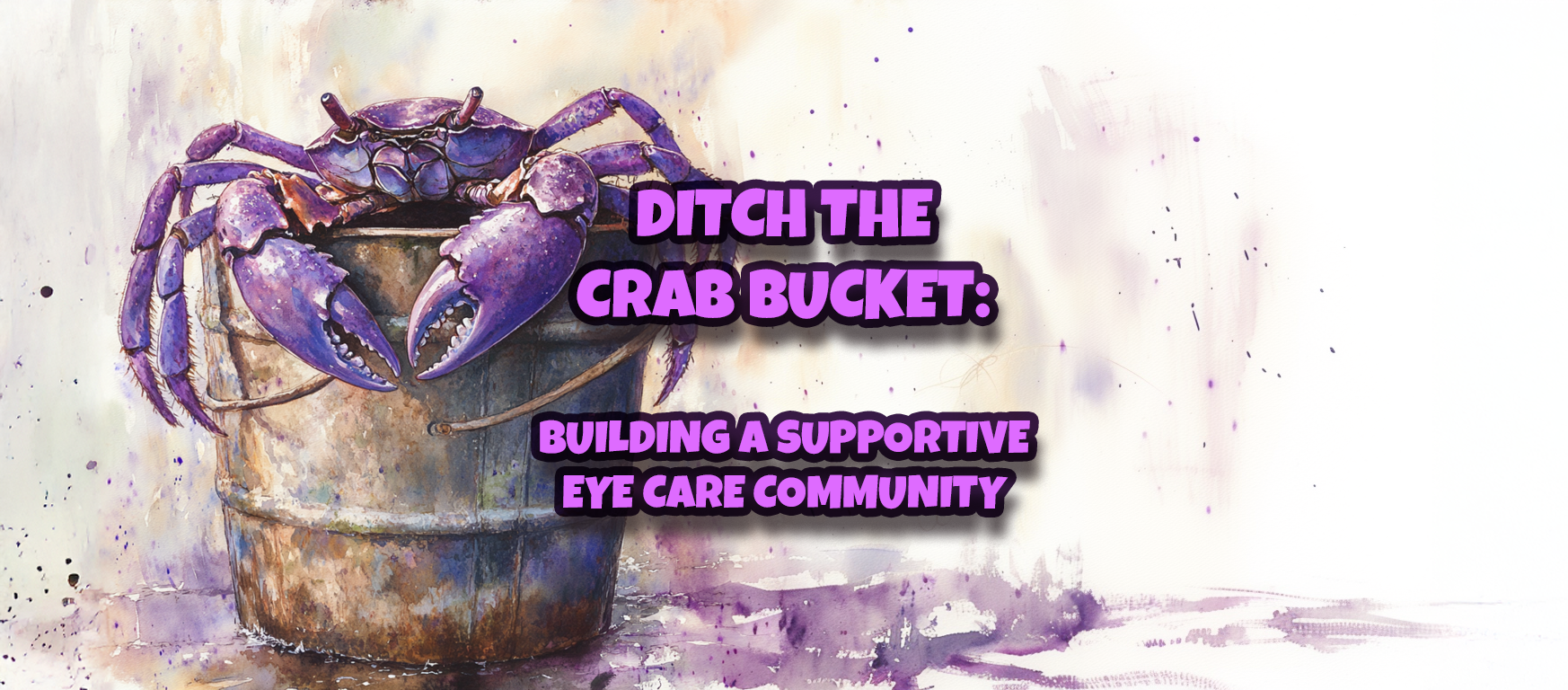
Have you ever felt like you were on the verge of a breakthrough, only to find yourself inexplicably held back? Perhaps you’ve experienced a subtle, or not-so-subtle, resistance from those around you as you pursued a new idea or a career advancement. This feeling, unfortunately, is not uncommon, and it’s often described using a vivid metaphor: the crab bucket phenomenon.
The image is a simple one: imagine a bucket filled with crabs. Individually, any one of those crabs could easily climb out and escape. Yet, when one crab attempts to ascend, the others, seemingly driven by an unseen force, pull it back down. The result? None of the crabs achieve freedom. This analogy sadly reflects a pattern of behaviour we sometimes see in our professional lives, including within the fields of academia, optometry, and healthcare. It’s a tendency where, instead of supporting each other’s progress, individuals may act in ways that hinder or undermine the success of their colleagues.

This post isn’t about pointing fingers or dwelling on the negative. Instead, it’s about recognising this crab bucket dynamic, understanding why it happens, and, more importantly, exploring how we can move beyond it. We’ll look at how this plays out in our specific sectors, share some personal experiences, and discuss practical steps we can take to foster a more supportive and collaborative environment. My aim is to provide a warm tone about being aware of this phenomenon, how we may feel when it is in play and how we can channel that around to provide a better service and experience for patients, whilst empowering ourselves in the process.
The Crab Bucket in Action
The crab bucket mentality appears in many areas. Sadly, academia, optometry, and healthcare are not immune. It can show up in subtle ways. Its presence might be hard to notice. Yet, its impact can be significant.
In academia, senior staff sometimes dismiss junior researchers and staff can be reluctant to share resources. Sometimes, they don’t want to share data that could help someone’s career. A professor might not acknowledge a student’s innovative thinking. Research teams often keep findings to themselves. They might not share them with the wider community. This crab bucket behaviour stifles innovation. It slows discovery. Ultimately, it harms the entire field.

Optometry helps people see their world more clearly. Yet, it also has instances of this mentality. A senior optometrist might discourage a new colleague from applying for a new role or training towards a specialty. Practice owners sometimes see other local practices as competition. They might want to undermine them, instead of seeing them as peers. We might even see subtle put-downs, or dismissive attitudes towards specialisms. These actions aren’t helpful.
Healthcare should be the epitome of collaboration. It should have a shared purpose. Yet, it can also fall prey to this phenomenon. Departments within a hospital might compete for resources. Some professionals resist new technology. They may fear disrupting established hierarchies. The crab bucket mentality creates mistrust. It hinders progress, wherever it appears. This is something we need to address.
My Escape From the Crab Bucket
I remember a time early in my career, where I was working for a building society. I knew that selling finance wasn’t the right fit for me. My boss and supervisor offered no support.
When I told them I was leaving for a job at a local eye hospital, they were negative. “You can’t do that“, they said. “If you can’t sell car insurance, what hope do you have looking after people’s eyes?“.
“You can’t do that! If you can’t sell car insurance, what hope do you have looking after people’s eyes?”
Jason’s ex-supervisor
Their words made me feel small. My confidence took a hit. But, I disliked my role and time there so much that their negativity became my motivation. I was determined to prove them wrong.
Why We Do It
Why do people engage in this crab bucket behaviour? It’s a question with complex answers. Often, it stems from insecurity. People may feel threatened by the success of others. They worry that someone else’s achievement diminishes their own standing. This creates a scarcity mindset. It’s the belief that there’s only so much success to go around. So, if someone else wins, you lose. This, of course, is a flawed way of thinking.
Fear also plays a big role. People may resist change. They might feel comfortable with the status quo. They may worry that a colleague’s progress will disrupt things. This can lead them to try and maintain control. Sometimes, this control manifests as hindering others.

But there’s more to it than just insecurity and fear. Social psychology offers some further explanations. Humans are social beings. We naturally compare ourselves to others. Social comparison theory suggests that we evaluate our own worth and abilities by looking at how we measure up to those around us. When someone in our peer group excels, it can trigger upward social comparison. This can lead to feelings of inadequacy or threat, especially if we perceive that person as similar to ourselves.
Furthermore, evolutionary psychology might also provide some context. Humans have evolved to be sensitive to social hierarchies and group dynamics. In our ancestral past, limited resources meant that an individual’s success could directly impact the survival chances of others in the group. While modern society is very different, some of these deeply ingrained tendencies still influence our behaviour. We subconsciously perceive a colleague’s success as a threat to our own position or access to opportunities.
These factors can create a fertile ground for crab bucket behaviour. When individuals feel insecure, fear change, or perceive a threat to their social standing, they may try to pull others down to protect themselves. This behaviour, though ultimately self-defeating, can provide a temporary sense of security or control.
Moving Beyond the Bucket
We’ve explored what the crab bucket phenomenon is. We’ve also examined why it occurs. So, how do we move past it? The solution lies in fostering a culture of collaboration. We must build a community that values mutual support.
This means actively challenging the crab bucket mentality. We need to recognise our own potential to engage in this behaviour. We must also be willing to address it when we see it in others. But, how do we create this shift? It starts with awareness. We need to be conscious of the subtle ways this mentality can manifest. Are we celebrating our colleagues’ successes? Or do we feel a twinge of envy? Are we sharing our knowledge and resources freely? Or are we holding back, fearing it will diminish our own standing?

Open communication is also key. We need to create a safe space where we can discuss these issues without fear of judgment. This could involve regular team meetings, mentorship programmes, or simply fostering a more open and approachable work environment. By talking about these challenges, we can begin to break down the barriers that the crab bucket mentality creates.
Furthermore, we need to actively promote a culture of recognition and appreciation. When someone achieves something great, we should celebrate it. This not only makes the individual feel valued, but it also reinforces the idea that success is something to be shared, not feared. This shift requires a conscious effort. It’s about changing our mindset and our behaviours. It’s about moving from a place of scarcity to one of abundance, where we believe that everyone can succeed.
Practical Steps Away from the Crab Bucket
Here are some practical steps to help you recognise and address the crab bucket phenomenon:
Self-reflection: Regularly examine your own attitudes and behaviours. Do you feel threatened by the success of your colleagues? Are you always comparing yourself to others?
Active listening: Pay close attention to the language used by yourself and others. Do you hear subtle put-downs or dismissive comments?
Offer support: Make a conscious effort to help your colleagues. Share your knowledge and resources. Celebrate their achievements.
Seek out mentors: Find people who embody a collaborative spirit. Learn from their example.
Speak up: If you witness crab bucket behaviour, address it in a constructive and respectful manner.
Promote open communication: Encourage open dialogue within your team or organisation. Create a safe space for people to express their concerns and ideas.
Recognise and reward collaboration: Implement systems that reward teamwork and mutual support, rather than individual competition.
Lead by example: Demonstrate the behaviours you want to see in others. Be supportive, encouraging, and collaborative in your own interactions.
Empowering Others: An Example
As the author of this website and the author of a book for optometry students, I am occasionally asked “Why should I buy your book over the others out there?” For me, the reply feels naturally simple. “Why just pick one?”
“Why just pick one?”
Jason Searle – The Eye Care Advocate
Instead of positioning my work as superior, I emphasise that each author offers unique insights and experiences. I want potential readers to consider all available resources, empowering them to choose the book and tuiton that best meets their needs.
This approach applies to many other situations. I extend this philosophy to my interactions with peers. I celebrate their achievements, share opportunities, and offer support whenever possible.

Conclusion
The crab bucket phenomenon is a challenge, a hurdle we can overcome. Overcoming it isn’t just about individual success; it’s about the health of our professions. By understanding its roots, by recognising the subtle ways this crab bucket mentality can manifest, we can break the cycle. We can create a healthcare environment, in academia, in optometry, and in every facet of medicine, where everyone feels supported, where collaboration thrives, and where everyone can thrive.
If this article has been useful to you and you would like to share with your colleagues and peers, please do. Social sharing buttons are below:
If you wish to be notified of future posts, please subscribe to our mailing list:
and if you wish to access our Skill Centre content – you can sign up for free membership below.

And if you wanted a little more on the crab bucket phenomenon then be sure to check out:
The Crab Mentality Disease: How to Identify and Overcome Crab Mentality Disease & Virus in Yourself or Others – Book
(Available on Amazon – we may receive a small commission if you purchase via this link)
Leave a Reply