
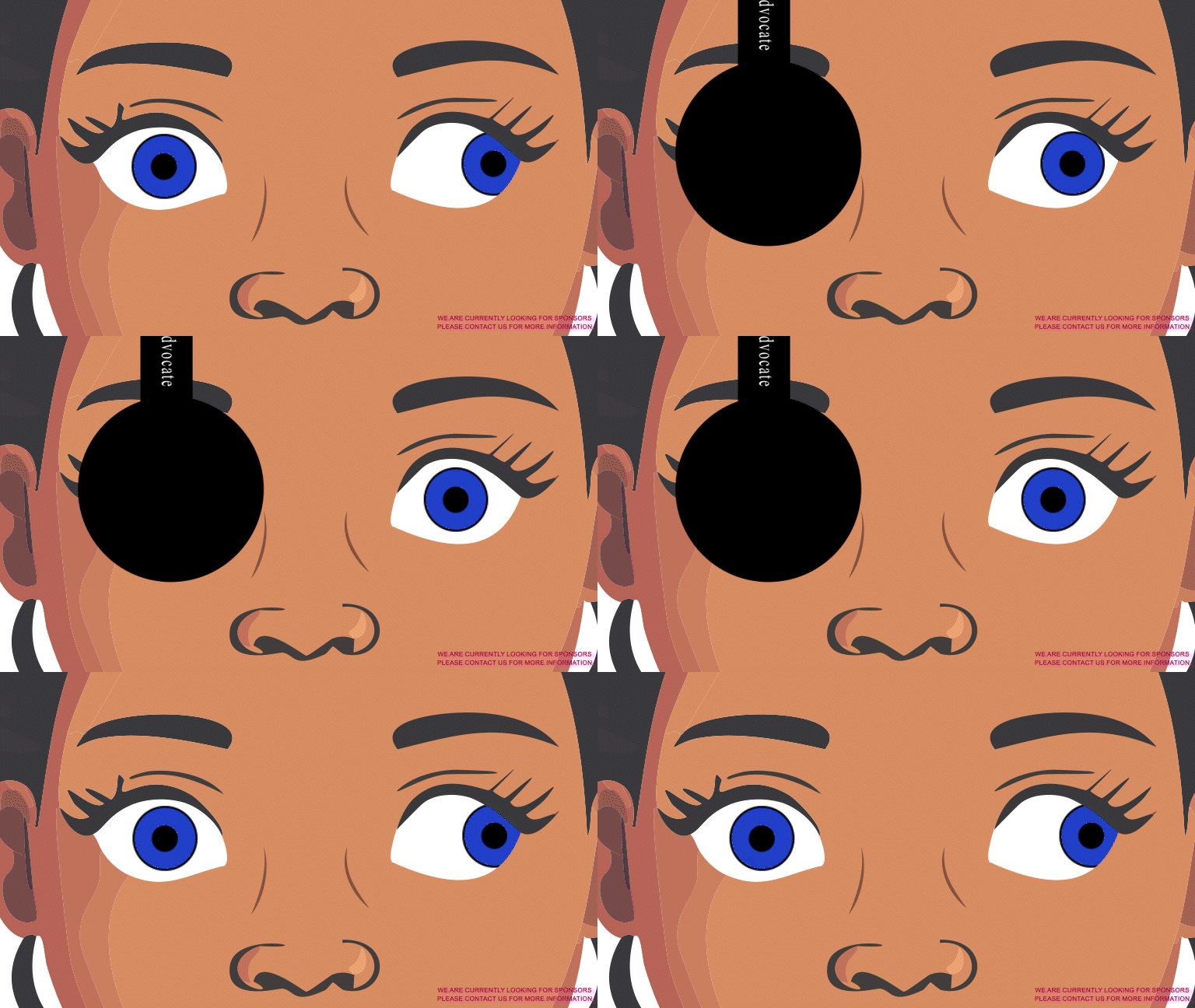
Introduction to the Cover Test
The cover test is a fundamental diagnostic tool used by optometrists, orthoptists and ophthalmologists during eye examinations to objectively assess the alignment of the eyes and to detect any misalignment. As optometrists working in primary care, a binocular vision assessment should be performed at every eye examination1,2, with the cover test being the bare minimum method of assessing it1,2. The test itself assesses for the presence or absence of motor fusion3, which is required for bringing the eyes into alignment.
The Types of Misalignment
There are two types of misalignments that you may encounter when you are assessing the binocular vision status of a patient; the tropia and the phoria2. Both can cause difficulties for your patient, but due to the fact they have different causes and indications, thorough assessment and identification of the type of misalignment that is present is required to manage your patient appropriately. Both can be detected using the cover test2.
Tropias
A tropia, or full name “heterotropia”, is a manifest misalignment of the eyes. This means that the deviation is always present, even when both eyes are open and attempting to work together2,3 (however, management steps in heterotropia can correct for this deviation in some cases – but this will be discussed in a later article).
They often tend to be of a large angle, meaning the deviation is often visibly apparent when looking at the patient – but this may not always be the case. In some patients, a very small angle tropia may be present, meaning that careful observation to detect it is required2.
The left eye has a manifest outward deviation. In this case the heterotropia is obvious when looking at the patient.
These deviations are usually easily detected when using the cover/uncover test, but care must be taken to ensure small angle deviations are not missed in otherwise asymptomatic patients2.
Phorias
A phoria, or full name “heterophoria”, is a latent misalignment of the eyes. These deviations only become apparent when the patient’s binocular viewing, that is when the eyes are working together and looking at the same object, is disrupted2,3.
Phorias can be a range of sizes, from negligible misalignment, to large-angled that break down into temporary tropias2,4. They tend to appear when the binocular system is fatigued – either when the patient is tired, ill or has put their eyes through a lot of strain throughout the day (such as reading for prolonged periods of time on a computer).
These deviations are normally spotted on the cover/uncover test – especially if moderate to large in size, but can often be seen more clearly when performing the alternating cover test5, as this test adds more disruption to the binocular system and as such exacerbates the misalignment2.
This patient has a latent inward deviation that only occurs when binocular viewing is disrupted. This inward deviation would also occur in the patient’s left eye if the left eye was covered.
Additionally, both heterophorias and heterotropias can be present, or differ in magnitude, at both distance viewing and near viewing3,5 and as such ocular alignment must be assessed at distance and near.
Directions of Misalignment
There are several directions that the eye can misalign. The following text and animations demonstrate the deviations.
Eye Deviates Up: An eye that deviates upward is a hyper-deviation. If it is a manifest upwards deviation it is known as a hypertropia and if it is a latent upwards deviation then it is a hyperphoria2,3.

Eye Deviates Down: An eye that deviates downward is a hypo-deviation. If it is a manifest downwards deviation then it is known as a hypotropia and if it is a latent downwards deviation then is a hypophoria2,3.

It should be noted that a hypertropia in one eye will expect a hypotropia in the other eye, except in cases where Dissociated Vertical Deviation (or DVD) exists, where there is a slow, upwards drifting of the covered eye when the fellow eye is fixating6 and occurs bilaterally.
Eye Deviates Outwards: An eye that deviates outwards (i.e. temporally and away from the nose) is known as an exo deviation. If the outwards deviation is manifest then it is an exotropia and if it is a latent outwards deviation then it is an exophoria2,3. An easy way to remember this is that “exo” shares its first two letters with the word “exit”, which has a synonym of “out”. Therefore exo = out.

Eye Deviates Inwards: An eye that deviates inwards (i.e. nasally/in towards the nose) is known as an eso deviation. If the inwards deviation is manifest then it is an esotropia and if the inwards deviation is latent the it is an esophoria2,3.

Rotational Deviations: There are some deviations where the eye rotates around its anterior-posterior axis and these can be both phorias and tropias. A rotated eye will not provide retinal images that match and can lead to binocular vision problems. If the eye rotates inwards upon its axis, it has the prefix “incyclo-“ and if the eye rotates outwards upon its axis it carries the prefix “excyclo-“2,3.
Magnitudes and Recovery
The misalignments found in binocular vision can vary both in size/magnitude and the ability of the binocular vision system to handle the misalignment.
Heterotropia: These, unless present from a very young age, can cause double vision as both eyes are misaligned. Usually these present from systemic pathology, which is currently out of the scope of this particular article. At a young age, the brain can adapt to suppress the second image it sees from the deviated eye and can lead to amblyopia (also known as “lazy eye”). They can be treated using refractive correction with prism (although in some cases correcting the ametropia alone) or surgery.
Heterophoria: These are very much important to assess the size and recovery of. In many cases, heterophoria are well compensated (that is, the binocular vision system corrects for the misalignment to prevent diplopia) and generally, the smaller the phoria the less effort is involved in keeping it under control. If a patient has a significant phoria, the binocular vision system requires more effort to control it and prevent it from decompensating into a tropia.
Therefore noting the size and how quickly a phoria recovers from being covered can test how robustly it is being compensated and may shed further light in complaints of aesthenopia or the reports of diplopia after prolonged concentrated tasks2.
Vertical Deviations: It must also be noted that the binocular vision system is very good at compensating for horizontal deviations, but less so at vertical deviations2. Keep in mind this fact when assessing patients with vertical diplopia or vertical deviations – that a small deviation in the vertical direction will require further investigation and management.
Equipment Required to Perform the Cover Test
Essentially, the only equipment that you require to perform these tests are an occluder and fixation targets at distance and at near, both easily found in optometric testing rooms. If you are a student and wish to build your skills in these tests away from a clinical setting (i.e. for exam practice – NOT for diagnostic purposes) then check out The Eye Care Advocate’s post: Learning Clinical Skills at Home: Budget Equipment for Student Optometrists, which provides advice on makeshift testing equipment for those that do not have access a testing room, or its equipment, and wanting to hone their practical revision.
For the distance fixation target, ideally use a letter on the line above the patient’s worst acuity with the occluder to perform the test. The cover test at near will require a near fixation target, such as the budgie stick, and ask the patient to fixate on a letter on the line above the one they can read at near. In children, suitably sizes images should be used to gain the required fixation.
How to Perform the Cover Test
As mentioned above, there are two cover test techniques that can be utilised that will help to identify if the patient has a heterotropia or a heterophoria. This section will provide a guide on how these tests are performed.
Part 1: The Cover/Uncover Test
The cover/uncover test is the most essential of the two versions of the cover test as it is the only one that will differentiate between a heterophoria and a heterotropia, whilst also allowing assessment of the presence of a heterophoria. Please do not be tempted to skip this test and/or only perform the alternating cover test!
Step One: Preparation2
In performing the cover/uncover test for distance and near, you aim to test the patient whilst they are wearing their habitual correction for each of the distances. If they do not wear spectacles at all, then this would be done without spectacles, but if they wear separate pairs for distance and near, then they will need to wear the corresponding correction for each distance tested.
Keep the room lights on, as this will aid your ability to see the patient’s eyes, as you will need to be assessing them from behind the occluder. Be sure to explain to your patient what you are doing, why you are doing it and make your instruction clear, so they know what they need to do during the test.
Step Two: Target Selection2
The distance cover/uncover test should be performed after you have a distance visual acuity measurement with the patient in their habitual correction. You should select a letter that appears on the line above the lowest distance acuity measured, as to allow the eye to keep fixation on the target.

In cases where the acuity in poorer eye is 6/18, Elliott2 suggests using the spotlight on the chart instead. However, it could be argued that this switches the target from an accommodative target to a non-accommodative target, so others have suggested using a letter on the line above lowest acuity with a key joining feature (such as the centre of an X, or the point of an A or V), where the patient can easily maintain fixation on the portion described, thus keeping the target accommodative.
For the near cover/uncover test target, you can use the same principle by selecting a letter higher than the lowest read on the small Snellen scale on the back of the budgie stick or, failing this being available, a small and accommodative target that can be seen easily by both eyes individually. Please note, larger and pictoral targets may not provide a stimulus that may be strong enough to induce accommodation2 and as such may reduce the accuracy of the cover test. The target should be held approximately 40 cm away2,3.
Step Three: Assess for Heterotropia2
Sitting directly in front of your patient, at a distance of 30-40 cm away, cover the patient’s left eye, whilst watching the right eye (the uncovered eye). If the right eye moves to take up fixation, then there is a tropia in the right eye. Note the magnitude and the direction of movement as this will help describe the tropia. Repeat this at least three times to fully understand the movement that is taking place. If the eye stays fixating and no movement is seen, proceed to perform the test by covering the right eye and watching for movement on the left eye.
Be sure to maintain the cover in place for 3 seconds, as it can take a few seconds for the non-fixating eye to take up fixation2. You will also need to remember that the movement direction will be opposite to the position the eye is misaligned (so a movement inwards will indicate the eye was in an outwards position and so forth).
An animation showing the cover/uncover test can be seen below and demonstrates the test on a patient with a left exotropia.
If a heterotropia has been detected, it is impossible, by definition, that a heterophoria will be present so the alternating cover test is not required2. However, if you pick up a heterotropia at distance then make sure you also assess it’s magnitude at near, as accommodation and convergence mechanisms will likely cause some difference in the misalignment at each distance.

If a heterotropia has not been detected (i.e. no eye movement on the cover component) then assess for heterophoria. This can be done by assessing the movement of the covered eye when performing the cover/uncover test and noting the latent deviation. However, this will be more noticeable in the alternating cover test, as explained in part 2 below.
Part 2: The Alternating Cover Test
The alternating cover test should be performed upon ruling out heterotropia, as this test will not allow you to determine if the movement that you are witnessing is caused by a tropia or a phoria. Therefore remember to perform the Cover/Uncover test prior to performing the alternating cover test.
Step One: Preparation2
Preparation for the alternating cover test should follow on from the cover/uncover test. The lights should be on, the patient should be in their habitual correction and looking at the appropriate target (as explained in Part 1 above). It may be at this point that you remind your patient to keep fixating on the target.
Step Two: Alternate Occlusion2
With the patient fixating at the required target, occlude one eye for 3 seconds2 and allow the non-occluded eye to take up fixation. After the 3 seconds, quickly move the occluder to occlude the other eye and hold for at least 3 seconds. Keep repeating this step throughout the process, ensuring the eyes never view the target binocularly (i.e. ensure one eye is covered at all times) and enough time is allowed for the eye to take up fixation on each cover.
Step Three: Assess Heterophoria2
When the occluder alternates between the eyes, you are looking for the recovery movement the occluded eye makes as it takes up fixation. As described above, the movement will be in the opposite direction to deviation (e.g. if the eye is moving inwards on recovery, it was in an outwards and exo- position).
It is a good habit to also look at the covered eye whilst it is covered (by either using a frosted occluder or by looking around the occluder at the covered eye). This will allow you to see the eye in the latently deviated position and may aid in working out the direction the deviation if you are unsure of what movement the eye is making. The result of seeing the eye deviated should correspond with the suspected movement, so it can help confirm your findings.
An animation showing the alternating cover test on a patient with moderate esophoria can be seen below:
Step Four: Ask the Patient2
In some cases, the movement may be so small that you may either not see it to assess its direction or even see the movement at all. This is where you can ask the patient to provide some input: ask them if they see the target moving.
If they do not see the target moving on each alternation, then the eyes are stationary in primary gaze and no misalignment is occurring. If they notice the target is moving, then this is their sensory perception from the motor fusion correcting for the heterophoria present. Furthermore, if they say the target “follows” or goes “with” the direction of the occluder then they are experiencing the recovery of an EXOphoria and if it goes in the “opposite” direction and “against” the movement of the occluder, then they are experiencing the recovery of an ESOphoria2.
These subjective responses are called “phi”2 and should be noted, alongside the relevant phoria direction when recording.
What to Record
As there are so many factors to consider in the process of assessing a patient’s binocular vision status, knowing what to record to adequately document what you have seen may feel overwhelming. The good news is that you really can say what you see!
No Phoria/No Tropia Seen: If there is no phoria or tropia detected, then you can note that as such. “No Movement Detected” or “NMD” is also commonly accepted2. Where possible, try to avoid using the term “ortho” when performing the test objectively, as this indicates no phoria or tropia when potentially the patient has a very mild one that was unable to be seen clinically2. However, if the patient was asked if the target moved and they reported that it did not move, this is where you can use the term “ortho”2.
Heterotropia: If you detect a tropia, record the eye it affects, the direction of the deviation and an indication of the size of the tropia. Additionally it is important to note if the tropia is present intermittently or if it is constant, as if not noted, many will assume the tropia is constant2, which may lead to potential issues in management further down the line.
For ease of recording, eso- deviations are abbreviated to SO and exo- deviations are abbreviated to XO. In terms of tropias, add the suffix “T” to indicate it is a tropia (so that and esotropia is noted as “SOT” and exotropia as “XOT”)2.
Heterophoria: If a phoria is detected then record the direction, an indication of the size and the characteristics of its recovery (e.g. fast or slow, smooth or jerky). As above, the directions can be noted as SO and XO and suffixed with a “P” to indicate the deviation recorded is a phoria2.
A note about size/magnitude. In some cases, an approximation of the size can be noted (such as a small, medium or larger) but in cases of management it is often best to measure the size of the deviation. This can be done by neutralising the movement on the alternating cover test whilst using prisms2,5 (often with a prism bar) where appropriate). Student and pre-registration optometrists should try to measure the size in this way wherever possible so they can gain experience on what different sized deviations look like to allow better estimation when working when fully qualified.
Common Mistakes When Performing the Cover Test
Below is a list of common mistakes that both optometrists and optometrists-in-training tend to make when performing the cover test.
- Blocking the view of the distance target during distance cover test. This prevents the patient fixating and will cause anomalous eye movements and confusion to the patient throughout the test.
- Missing a tropia in an amblyopic eye through poor target selection. By not providing an appropriately large enough target during cover testing, a poorer eye may not take up fixation on covering of the dominant eye and as such not allow detection of the tropia.
- Alternating too quickly. Many students that I have seen perform this test seem to want to get the cover test done and out the way quickly. This results in the occluder alternating several times in a time period of 3 seconds, as opposed to the ideal once per 3 seconds. The eyes do not have a chance to fully dissociate, nor a chance to retake fixation, leading to clear phorias being missed.
- Allowing binocular viewing. The cover test is designed to prevent binocular viewing. Through poor technique, it may be that the covered eye may not be occluded appropriately or, when alternating, the cover is not going from one eye directly to the other. This will allow binocular viewing conditions and defeat the aim of the test.
- Not repeating. In some cases, some students may wish to just do the test once and record their findings. Repetition allows for confirmed findings, ensures the patient is performing the test correctly and aids in ruling out any movements that may occur from the patient not fixating correctly or having loss in concentration.
- Not checking results make sense. All results should confirm each other. If you see an inward movement , then the eye would have been in an exo- position and the phi movement would have been following or with. If any of these results contradict themselves – double check the findings.
Summary
In summary, it can be seen that the cover test, and its variants, is a vital tool in assessing the binocular vision status of a patient and the identification of ocular misalignment. This relatively simple test has several steps, but it is clear that each step must be performed with the correct technique and purpose to prevent errors and to fully investigate the alignment of a patient’s eyes.
If this content has been useful, please consider subscribing. Subscribing shows support for The Eye Care Advocate, as well as letting us know that the content is needed and will allow us to further create it on an on-going basis. Not wanting to subscribe? Not to worry, drop a comment below if you have found the article helpful – or if there is anything that you wish to add!
Skill Activity
Further Reading
- College of Optometrists (2023). Knowledge, skills and performance: the routine eye examination or sight test. [Online.] Available at: https://www.college-optometrists.org/clinical-guidance/guidance/knowledge,-skills-and-performance/the-routine-eye-examination#Conductingtheroutineeyeexamination [Accessed: 13th May 2024].
- Barrett B, and Elliott DB (2007). Assessment of binocular vision. In: Ellott DB. 3rd ed (2007). Clinical Procedures in Primary Eye Care. Philadelphia: Butterworth Heinemann, pp. 151-219.
- Goyal A (2023). Assessment of binocular vision. In: Mravicic I, and Pjano MA (2023). Treatment of Eye Motility Disorders [Working Title] [Online.]. Available at: https://www.intechopen.com/online-first/1157694 [Accessed: 13th May 2024].
- Biler ED, Yilmaz SG, Kucukceran E, and Uretman O (2017). The effect of convergent and divergent stress on near stereoacuity. International Ophthalmology 37: 165-168.
- Goering M, Drennan KB, and Moshirfar M (2024). Convergence insufficiency. StatPearls. [Online.] Florida: StatPearls Publishing. Available at: https://www.ncbi.nlm.nih.gov/books/NBK554390/ [Accessed: 17th May 2024].
- Kaur K, and Gurnani B (2023). Dissociated vertical deviation. StatPearls. [Online.] Treasure Island: StatPearls Publishing. Available at: https://www.ncbi.nlm.nih.gov/books/NBK573061/#:~:text=Dissociated%20vertical%20deviation%20(DVD)%20is,a%20cover%2Duncover%20test). [Accessed: 17th May 2024].

Leave a Reply